
Staff Spotlight: Megan Hallof
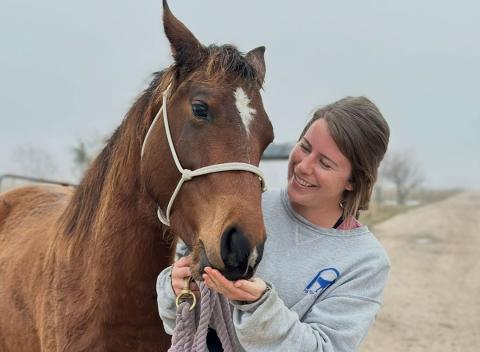
Staff Spotlight: Megan Hallof
Meet Megan Hallof, one of our miracle workers here at the ranch, our volunteer coordinator and in-house donkey specialist. Megan just celebrated three years at Habitat for Horses and has fostered a love for equines her whole life.
Q: How long have you been with Habitat for Horses? What’s your favorite part of your day-to-day life at the ranch?
Megan: I just celebrated my three-year anniversary at Habitat in December 2025! On my first day, I arrived at the ranch as the sun rose behind the silhouettes of our horses, and I remember feeling so lucky that this was my career. My favorite part about working at Habitat is seeing the transformation our horses make over time — physically and mentally. It's difficult seeing them in the condition they arrive in, but every positive stride they make toward being a happier and healthier horse is so rewarding!
Q: We know you can’t pick a favorite resident at the ranch, but if you had to… Who’s your favorite and why?
Megan: If I had to pick a favorite resident at Miracle Ranch, it would be Kahawa. She's a 20-year-old grulla mare who may possibly be one of our sweetest horses on the ranch. I started working with her in 2024 and quickly discovered that she likely had some pretty harsh and heavy-handed riders on her in the past. She was dull to cues, unwilling to move and showed many signs of stress and learned helplessness. So I restarted her with gentle positive reinforcement training, and I saw the light return to her eyes. She loves playing R+ "games" and is incredibly smart, which makes her very fun to work with. She has a long way to go in her training before she's truly rideable again, but using force-free methods has helped her regain confidence and restored her motivation to partner with humans again.
Q: How did you get into equine work initially? Did you have horses or donkeys growing up?
Megan: I grew up in the suburbs of Tulsa, Oklahoma, as the youngest of four kids, so owning horses was out of the question for me at the time. Even though I didn't grow up with them, I've always loved them from a very young age.
My first exposure to horses was on guided trail rides, and from the second I sat in the saddle, I was hooked. It wasn't until college that a mentor gave me the opportunity to learn about and ride his horses for free on a more consistent basis. I rode several times per week and learned about equine nutrition, medical care and hoof care. After college, I worked at a summer camp as a trail guide.
This was an incredibly rewarding experience — helping young kids overcome their fear of horses, hopping in the saddle and hearing them say they want to take their trail horse home by the end of the ride. I think I loved it so much because that's how I first fell in love with horses so many years before. Now, thanks to my and my husband's hard work, I live the life I always dreamed of with a horse and two donkeys who I adopted from Habitat!
Q: So you’re a donkey farrier and you adopted two donkeys from Miracle Ranch. What makes donkeys special to you?
Megan: Last year, thanks to Habitat's emphasis on continuing education for employees, I learned how to trim donkey hooves in order to better help our feral donkeys at the ranch! It's been incredibly impactful for the care of our donkeys, leading to many of them getting adopted last year! I knew very little about donkeys before arriving to Habitat for Horses, but quickly fell in love with their long ears after interacting with them and learning more about them.
Donkeys are often misunderstood as stubborn and misbehaved, but in reality, they are often very fearful due to harsh handling practices they've experienced in the past. Donkeys often take longer than horses to trust humans, so I build trust with them through positive reinforcement and force-free training methods. Once they start to trust you, they are incredibly sweet and lovable! Donkeys (unlike most horses) have a tendency to really enjoy scratches on their cheeks, ears and foreheads and are content spending hours with humans to snuggle. It's their calm nature and sweet dispositions that draw me to them!
Q: Can you tell us a little bit about your work to train volunteers and why they’re so important to the organization?
Megan: I stepped into my role as volunteer coordinator in 2023 and have truly enjoyed helping our volunteers learn and grow! Our volunteers have an incredible impact on the lives of the horses at Miracle Ranch. Most volunteers enjoy going out to the pasture and grooming horses, while others enjoy helping in the barn, taking photographs, helping with special projects around the ranch and much more!
It's evident to me how much they care for our horses and our organization. I don't think they fully realize how important they are to us! It's truly difficult to put into words how much we as a staff appreciate their hard work and dedication to our herd. For many of our horses, our volunteers are some of the first humans to treat them with respect, love and kindness!
Q: You also do behavioral work with the “harder to handle” equines at the ranch. What was your worst moment working with a horse who you were trying to help? What was the best? Why?
Megan: I absolutely LOVE behavioral work! It's almost like a problem-solving puzzle because so many different factors play a role in why a horse is behaving in a certain way. Unfortunately, it can also be a bit of a guessing game since we don't know for certain the traumas our horses have experienced in the past. I don't really have a "worst" case and "best" case in terms of behavior modification training, but I will say it can be quite a roller coaster at times! Horses will make great improvements for several sessions in a row, and then suddenly regress or have bad days. When this happens, I do my best to remember that this is all part of the natural learning process.
Q: What do you think people misunderstand about your work as a trainer? What about Habitat for Horses’ mission overall?
Megan: As a primarily positive reinforcement trainer, a lot of people misunderstand this training method as being "soft" and creating "pushy" horses. The opposite couldn't be more true though! Positive reinforcement training focuses on implementing important boundaries and motivating horses to willingly participate — all while placing high importance on the horse's mental safety and well-being. I think people often misunderstand the mental aspect of Habitat's mission as well! Of course, our goal is to physically rehabilitate horses and make them healthy again. But our mission also includes offering a safe environment where horses don't have to be fearful of the humans they interact with anymore.