
Staff Spotlight: Cheyenne
Headline: Staff Spotlight: Cheyenne
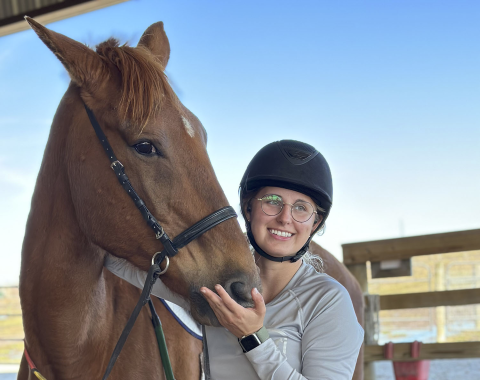
Meet Cheyenne, our Equine Manager and miracle maker here at Habitat for Horses. Cheyenne just celebrated three years on the ranch — but she’s been “doing horse stuff” since she was a baby!
Q: How long have you been with Habitat for Horses? What’s your favorite part of your day-to-day at the ranch?
Cheyenne: I have been with Habitat for Horses for 3 years now! Narrowing down my favorite part of the day-to-day at the ranch is extremely difficult, but I have gotten it down to 3 main things that I absolutely love. The first is our team and the horses. It is extremely gratifying working alongside humans and horses that are often so joyful and uplift spirits at every turn. The second is making microadjustments to feed and daily care that positively impact our horses’ quality of life in a big way. Lastly, my favorite part is that every day requires problem-solving in some way. It could be planning large moves of 50 to 100 horses to different pastures, working out a behavioral challenge for a specific horse, or dealing with an emergency. The days here at Habitat for Horses strongly resemble the horse itself – they are rarely the same and require flexibility above all – and I love it.
Q: How did you get into equine work initially? Did you have horses or donkeys growing up?
Cheyenne: I was born into an equestrian family; I was doing horse stuff from an age so young I don’t have full memories of it. The first time I rode a horse I was about one year old with my mother, and I started riding lessons when I was about five years old. We had horses at our family farm (between 6–10 horses at a given time), and I had personal horses boarded at the show barn I rode at. I was lucky enough to have the support to be able to show several horses in the Hunter/Jumpers on the national “A” Circuit. I learned equine husbandry primarily from my mother, grandfather, and trainer in my early years. I took a lot of pride in caring for my horses myself – rather than relying on grooms, which is common in Hunter/Jumpers.
Q: You’ve been at the Ranch for some really tough rescues — they were abused, neglected, or worse. Can you walk us through your early interactions with these horses? What is it like to earn their trust? How does your approach change given their circumstances?
Cheyenne: Whenever I approach a horse for the first time, I try to make sure I am in a calm state through my breathing being slow, my adrenaline is down, and my headspace is neutral. (I have worried a coworker more than once by taking these massive deep breaths to lower my heart rate and breathing rate!) I move slowly and speak to them – I will call them “love” or “handsome,” ask them questions, tell them that I know what I am doing is scary or weird.
My responses and actions will change depending on the horse themselves. I have been on rescues with horses that are comfortable with people and those that have had either little or bad experiences with humans. With horses who are comfortable with people, I will offer scratches, pets, and snuggles if they’d like. However, with horses who are spooky, it is a slower process to gain their trust. I will physically move much, much slower while also adjusting my approach, forward and backward, based on the horse’s body language – typically all while speaking to them.
If able, I will use senior grain to help ease their anxiety about me. I also tend to be very direct to the humans around by requesting them to stop moving, quiet down, or leave the area. In those situations, I take the horse’s stress very seriously because it can become dangerous quickly. Overall, the biggest factor is that I remain calm while being aware of the changing variables to adjust the plan of action as needed based on what the horse is telling me.
Q: Are there one or two examples that really stand out in your mind?
Cheyenne: I think one of the biggest moments that stands out to me is about Josie. Josie is a semi-feral mare who really dislikes poll pressure and was pretty skittish around people when I first started working with her. My goal for her was to get her to the point of being able to have a dental exam done. This would require her to lead, enter a stock, and receive an injection for sedation. She is a positive reinforcement horse.
We first started with tolerating a halter and being okay with a lead rope, then moved on to leading. She did great at this! We slowly built a bond, and I was very close to moving to stock work. Unfortunately, I was working with her on a windy day when another horse in her herd spooked, causing her to spook. She hit poll pressure and spooked harder. She ran around her pasture with a halter and lead rope on for about 10 minutes before she calmed down enough to let me get closer to her again. Once close enough, I pulled on the safety release knot on my halter – and she was free.
It took two months after that point for her to fully trust me again – it was a long setback, but not an uncommon one when working with a feral horse. It was during that time that I decided to forego using a halter with her to transition her fully to liberty training. She LOVES liberty training! She walks with me as if she is on a halter and learned how to accept injections and to calmly walk into the stocks. So about one and a half years after I started working with her in September of 2024 – Josie got her teeth done!
It was a monumental accomplishment for her... and for me. Today, she will find me in the pasture asking for belly rubs and willingly does liberty leading away from her friends. I love her, and I am so glad I am able to positively impact her quality of life through cooperative care.
Q: What do you think people misunderstand about your work as a trainer? What about Habitat for Horses’ mission overall?
Cheyenne: In my view, the biggest misunderstanding about my work as a trainer is the education behind the training I do. A lot of professionals in the equestrian world have hands-on experience learning to train horses or keep them calm – while I (along with Michelle) have higher education along with continuing education to support the methods we use while training. My BA (and half an MA) is in psychology, so I have a strong understanding of the different learning theories. The research shows that positive reinforcement training yields the strongest learning outcomes over the longest period – making it one of the ideal methods for training horses. However, the equestrian world in general pushes back against positive reinforcement training for a few reasons: 1) They don’t want the horse to become pushy around food, and 2) It is logistically difficult to use during under-saddle training. The first is a misunderstanding of how positive reinforcement works, and the second requires one to embrace being different.
I should state that the equine training I was exposed to growing up focused on negative reinforcement and sometimes punishment, which is the most common in the equestrian world. My personal transition from relying on the common “pressure and release” values of training started in my early twenties when I started to do research on training methods on horses in college, and fully solidified once I started working at Habitat for Horses under Michelle. Before working with Michelle, I had no other experience with a professional who used the learning theories and applied training methods based on scientific rigor, versus the way it “has always been done.” I have found it to be an absolute pleasure to be able to train and teach horses using positive reinforcement while also teaching a horse the “rules” of negative reinforcement. I personally think that it is important that a horse can be handled by the general horseperson, which requires them to know the rules of negative reinforcement so they can be calm and confident when being handled that way.
Lastly, to answer the second part of that question – I think amongst the equestrian population, the misunderstanding of our mission revolves around our feral population. It costs a lot of resources to not only care for a feral horse, but a considerable amount more for their training and the time it takes for us to enact contingency plans during illness, injury, or emergency.